

A wet ceiling beneath a skylight can make the glass seem like the obvious culprit. Often, though, the water is getting in around the unit, not through the glass. Failed flashing, a deteriorated curb, or blocked drainage paths can all be responsible. And sometimes the moisture is not a roof leak at all: it’s condensation, which calls for a different fix.
That distinction matters in Salisbury, MD, and across Delmarva, where coastal humidity can make condensation more common and salt air and moisture can speed up material wear. Before reaching for caulk, it helps to understand how a skylight sheds water and what the symptoms can tell you.
Why skylights have several places that can fail
A curb-mounted skylight creates a larger and more complicated roof opening than a typical vent pipe. The unit sits on a raised wood or metal curb, and water must be directed safely around the bottom, both sides, and top of the assembly. Each transition is a potential entry point if flashing is damaged, installed incorrectly, or no longer integrated with the surrounding shingles.
A vent pipe typically relies on one boot flashing. A skylight depends on several connected parts working together: the curb, the roofing layers, and flashing at multiple edges. Those layers need to overlap in a way that sends water downhill, much like shingles. A single poorly lapped section can let water moving down the roof slip underneath the assembly.
The glass itself is not always the problem. A leak may instead begin at an edge, a curb, or the flashing system around the unit. The curb matters, too: it raises the skylight above the roof surface and provides the base to which the unit attaches. It must be sound and properly protected from water. On Delmarva, humidity and salt air can shorten material lifespans compared with inland conditions, so wood curbs and sills may deteriorate sooner than homeowners expect. If the wood is rotted, caulk won’t restore it; the damaged curb needs to be replaced.
What a sound flashing installation involves
The exact details depend on the skylight model, roofing material, roof slope, and manufacturer’s instructions. On a shingle roof, the installation generally needs a continuous waterproofing layer at the curb and flashing that is integrated with the shingle courses, not simply laid on top or sealed over with a bead of caulk.
A common sequence is to apply self-adhering waterproof membrane around the curb, install the bottom apron flashing, weave side step flashing into the shingle courses, and install the head flashing at the upper edge. The manufacturer’s flashing kit should match the skylight model and roof covering. Details can differ between products, so a contractor should follow the instructions for the specific unit rather than improvise with generic metal or sealant.
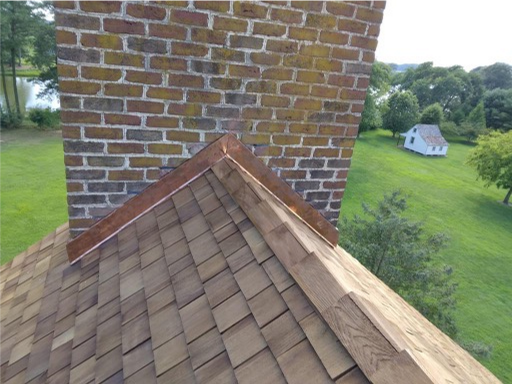
This photo shows flashing at a chimney, not a skylight, but it illustrates the importance of layered, water-shedding details.
One small detail is easy to overlook: many skylight frames have weep holes near the bottom to drain condensation that collects inside the frame. Do not caulk these openings shut. Blocking them can prevent water from draining and cause it to overflow into the frame or interior.
For another example of how small drainage clearances matter, see “Mind the Gap: Why J-Channel and Roof Flashing Should Never Sit Flush”. The skylight isn’t the same detail as a roof-to-wall intersection, but both depend on giving water a route to drain rather than trapping it.
Skylight leak or condensation? Look at when and where it appears
The timing and location of the moisture can offer useful clues:
- A roof leak is more likely when water appears at a flashing edge, around the curb, or along the framing during or shortly after rain or snowmelt.
- Condensation is more likely when droplets form on the room-facing glass or near the center of the frame on a clear, cold day, especially after cooking, showering, or a humid night.
Condensation may lessen when indoor air dries or ventilation improves. A rain-related leak, by contrast, is tied to wet weather. These clues don’t prove the cause, but they can help guide a proper inspection.
Delmarva’s coastal humidity can make condensation a familiar problem. If a homeowner assumes every drop is rainwater and repeatedly applies caulk, the real cause, such as high indoor humidity or inadequate ventilation, may go unaddressed. Caulking over a skylight’s weep holes can make the situation worse by blocking the frame’s intended drainage.
If the moisture appears during a storm, note whether it happens in ordinary rain or only during wind-driven rain. Strong winds, including those during a northeast nor’easter, can push water against flashing in ways a calm, straight-down shower does not. That pattern can help an inspector narrow down where water may be getting in.
Warning signs to look for
From inside the home, look for staining on the ceiling directly below or downhill from the skylight, dampness around the framing, or recurring moisture at the edges. Water can travel along framing or roof decking before it becomes visible, so the stain may not be directly beneath the entry point.
From the ground, binoculars may help you spot cracked or missing sealant, lifted or rusted flashing, or damage around the skylight. A soft or spongy curb is another reason to arrange a closer inspection. Do not climb onto the roof to investigate; roof surfaces can be slippery and unsafe, particularly after rain or a storm.
Repair, replace, or address indoor moisture?
A surface bead of caulk can sometimes act as a temporary patch, but it is not a dependable repair for failed flashing or a rotted curb. The appropriate fix depends on what an inspection finds:
- Clear, functioning weep holes and sound flashing: The moisture may be condensation, so investigate indoor humidity, ventilation, and insulation before applying sealant.
- A genuine flashing failure: Repair or replace the flashing using the system designed for that skylight and roof material.
- A deteriorated or rotted curb: Replace the damaged curb; caulk cannot make unsound wood structurally sound.
- A skylight at the end of its service life: Replacing the unit with a compatible manufacturer flashing kit may make sense. If a reroof is already planned, replacing the skylight while the surrounding shingles are open can be more practical than doing it as a separate job.
Repairs involving sealants need to follow the product’s temperature requirements. As fall temperatures drop, work may become weather-dependent; many sealants need conditions above roughly 40–50°F to cure properly. Mid-October is a useful time to have a skylight checked before colder weather makes scheduling certain repairs more challenging.

This broader roofing project shows underlayment and weather-barrier work; skylight flashing details should always follow the skylight manufacturer’s instructions.
For more on what a thorough, in-person roof evaluation includes, read “What a Roof Inspection Actually Involves (And Why We Don’t Use Drones)”. A skylight curb and flashing lap need close examination; an aerial image alone can’t determine whether a curb is soft or whether the flashing is properly layered.
Peninsula Roofing Company has served Delmarva since 1947. Our team provides free in-person inspections and honest repair-versus-replacement guidance. If you’re comparing roofing companies in Salisbury, MD, searching for a roofer in Salisbury, or looking for Salisbury roofers to assess a skylight, ask how the contractor will inspect the curb, flashing, weep holes, and attic, not just the glass. Peninsula Roofing also provides 24/7 storm response, and handles permits on replacement jobs.
If you see staining or recurring moisture, have the skylight details checked before the next storm. Contact Peninsula Roofing to arrange an inspection and find out whether the issue calls for a targeted repair, a replacement, or attention to indoor condensation.