

If you own or manage a commercial building in Salisbury, MD, choosing a new flat roof involves more than comparing estimates. The membrane you select affects energy use, maintenance, leak resistance, chemical durability, and how long the roof can protect your business.
The three most common single-ply systems are TPO, EPDM, and PVC. Each can be a dependable option when properly designed and installed, but the best choice depends on your building’s use, drainage, budget, rooftop equipment, and exposure to wind, UV rays, grease, or chemicals.
Here is how these systems compare for businesses throughout Salisbury and the Delmarva Peninsula.
TPO, EPDM, and PVC at a Glance
*These are general planning ranges, not formal estimates. Roof size, insulation, tear-off requirements, access, edge details, drainage improvements, flashing, and rooftop equipment can all affect final pricing.
What Is a Single-Ply Flat Roof?
Single-ply roofing uses a large flexible membrane installed over a commercial roof assembly. Depending on the building and system, the membrane may be mechanically fastened, fully adhered, or attached with a combination of methods.
The membrane protects the roof deck and insulation from rain, snow, wind, and ultraviolet exposure. Seams, penetrations, perimeter edges, drains, and flashing details are especially important because these are common locations for water intrusion.
Although these systems are commonly called “flat roofs,” most commercial roofs have a slight slope. That slope is essential. A roof should direct water toward drains, scuppers, or gutters instead of allowing it to remain in low areas.
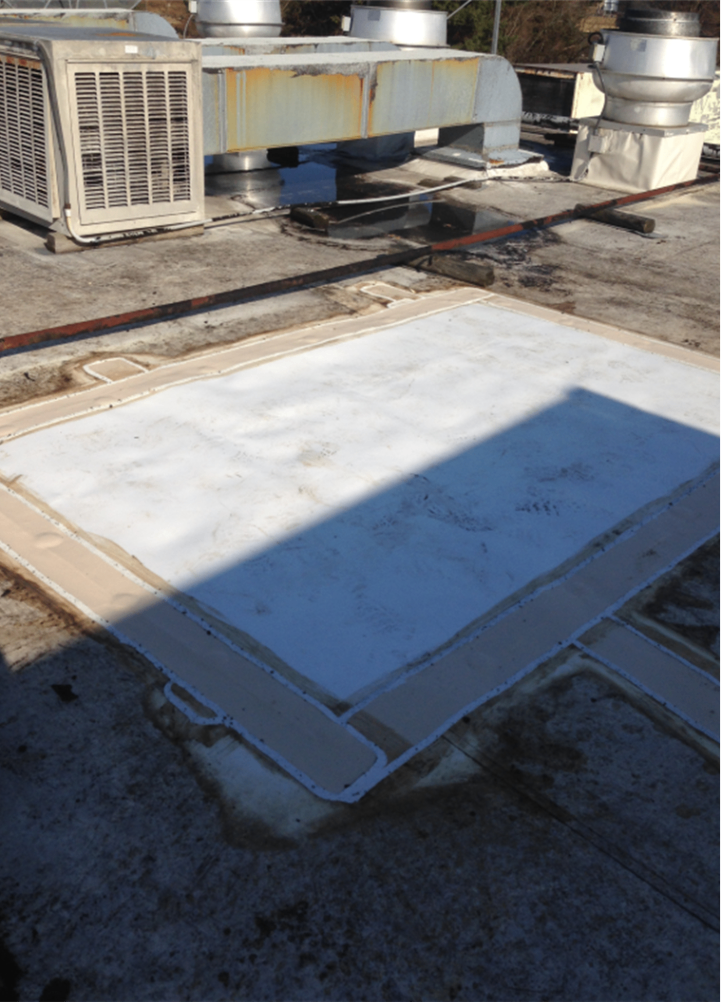
TPO Roofing: A Reflective, Versatile Default
Thermoplastic polyolefin, or TPO, is usually a white or light-colored membrane. Its seams are joined with hot-air welding, creating a continuous waterproof surface when the work is performed correctly.
Advantages of TPO
- Reflective surface: White TPO can reflect a significant amount of sunlight, helping reduce roof temperatures and cooling demand during Delmarva summers.
- Heat-welded seams: Properly welded seams are strong and watertight.
- Good value: TPO generally costs less than PVC while offering similar reflectivity.
- Versatile applications: It works well on many offices, retail buildings, warehouses, and other commercial properties.
- Clean appearance: The bright surface can give an older commercial property a refreshed appearance.
Limitations of TPO
TPO does not have the same level of chemical resistance as PVC. Grease, cooking oils, petroleum products, and certain industrial chemicals can degrade the membrane over time. A TPO roof may still be appropriate for a building with limited exposure, but areas beneath kitchen exhaust fans or near chemical discharge may require special protection or a different membrane.
TPO installation quality also matters. Seams must be properly prepared, welded, and tested. Membrane thickness can affect durability, so it is worth asking which product thickness and manufacturer system are included in an estimate.
Which buildings fit TPO best?
TPO is often the practical default for:
- Office buildings
- Retail stores
- Warehouses
- Churches and community buildings
- Light-industrial properties without significant chemical exposure
For many Salisbury businesses, a properly specified TPO system offers a useful combination of energy efficiency, seam strength, and manageable initial cost.
EPDM Roofing: Flexible and Budget-Friendly
EPDM is a synthetic rubber roofing membrane. Standard EPDM is black, although white and coated versions are also available. Its flexibility allows it to expand and contract as temperatures change.
EPDM seams are typically joined with adhesive or seam tape rather than heat welding.
Advantages of EPDM
- Lower initial cost: EPDM is commonly the most budget-friendly of the three systems.
- Cold-weather flexibility: The rubber membrane remains flexible during colder conditions, which can be helpful during seasonal installation work.
- Good durability: A well-maintained EPDM roof can last 20–30 years and sometimes longer.
- Ponding tolerance: The membrane itself is waterproof and can perform well when occasional water remains on the roof.
- Long track record: EPDM has been used on commercial buildings for decades.
Limitations of EPDM
The main concern is often the seams and flashing details. Adhesive and seam-tape performance depends heavily on proper preparation and installation. Over time, seams may separate, and flashing details can shrink or pull away if they are not correctly designed and maintained.
Black EPDM also absorbs more solar heat than a white TPO or PVC membrane. That may increase cooling demand during hot weather, particularly in buildings with air-conditioned interior space directly below the roof.
EPDM also has less resistance to grease, oils, solvents, and certain chemicals than PVC. It is not usually the first choice for a restaurant or industrial facility with significant rooftop chemical exposure.
Which buildings fit EPDM best?
EPDM can be a sensible choice for:
- Offices with limited rooftop chemical exposure
- Warehouses
- Storage buildings
- Small commercial properties
- Businesses prioritizing initial budget
EPDM can also be useful when a project must be completed during cooler months, provided the installation conditions and adhesives are appropriate.
PVC Roofing: Premium Chemical and Fire Resistance
PVC is a white thermoplastic membrane with heat-welded or solvent-welded seams. It is generally considered the premium option among these three systems because of its strong chemical resistance and higher upfront cost.
Advantages of PVC
- Excellent chemical resistance: PVC is well suited to grease, oils, food-service exhaust, and many industrial chemicals.
- Strong welded seams: Properly welded seams create a reliable waterproof layer.
- Reflective surface: White PVC can help lower rooftop temperatures and cooling loads.
- Good fire performance: PVC systems can provide strong fire-resistance characteristics when specified as part of an approved assembly.
- Long service life: Quality PVC systems commonly last 25–30 years or more with appropriate maintenance.
Limitations of PVC
PVC usually costs more than TPO or EPDM. That additional investment may not be necessary for a typical office or warehouse with minimal chemical exposure.
As with any membrane, poor detailing can cause problems. Even a premium material can fail around drains, penetrations, equipment curbs, perimeter edges, and improperly installed flashing.
Which buildings fit PVC best?
PVC is often the best fit for:
- Restaurants and commercial kitchens
- Food-processing facilities
- Hospitals and healthcare buildings
- Laboratories
- Manufacturing facilities
- Buildings exposed to grease, oils, or aggressive chemicals
If exhaust from a commercial kitchen regularly deposits grease on the roof, chemical resistance should be a primary consideration: not an afterthought.
Delmarva Considerations: Drainage, Wind, UV, and Humidity
Salisbury and surrounding Delmarva communities experience hot summers, winter freezes, heavy rain, coastal humidity, and periods of high wind. These conditions make roof design and installation especially important.
Heat-welded seams are valuable
TPO and PVC use heat-welded seams, which can provide excellent resistance to water intrusion when properly installed. Heat-welded seams are particularly useful in areas exposed to strong sunlight, wind-driven rain, and humidity.
EPDM can also provide reliable service, but its adhesive or tape seams require careful installation and routine inspection.
Drainage matters more than the membrane
Ponding water is one of the most common causes of premature failure on commercial flat roofs. Standing water adds weight, exposes seams and flashing to prolonged moisture, and can accelerate deterioration.
The answer is not simply choosing the membrane that tolerates ponding best. A proper roof assessment should evaluate:
- Drain locations and condition
- Roof slope
- Tapered insulation
- Crickets and saddles near equipment
- Scuppers and overflow drainage
- Blocked or undersized drains
- Structural deflection
- Deteriorated decking
PVC may handle chronic ponding better than TPO or EPDM, but drainage improvements are still necessary. No membrane should be treated as a substitute for sound roof design.
Reflectivity can help in summer
White TPO and PVC surfaces generally reflect more sunlight than standard black EPDM. That can help reduce rooftop temperatures and cooling loads during hot Salisbury summers. The actual energy impact depends on insulation, HVAC efficiency, building use, roof condition, and other factors.
Consider perimeter and wind-uplift details
The membrane is only one part of the roof system. Edge metal, fasteners, insulation attachment, flashing, and perimeter design all contribute to wind performance. A commercial roof in a coastal or storm-prone area should be designed according to the building’s exposure and applicable manufacturer requirements.
TPO vs. EPDM vs. PVC: Which One Is Right for Your Business?
As a general guide:
- Choose TPO when you want a reflective, energy-conscious roof with heat-welded seams at a moderate cost.
- Choose EPDM when initial budget, flexibility, and a long installation track record are priorities.
- Choose PVC when grease, oils, chemicals, fire resistance, or demanding rooftop conditions justify a premium system.
The right decision may also be to repair or restore the existing roof rather than replace it immediately. A professional inspection can determine whether the membrane, insulation, decking, drainage, and flashing are suitable for restoration.
One maintenance note: Peninsula Roofing generally advises against installing gutter guards. They can cause leaves and other debris to accumulate along roof eaves, trap moisture, and contribute to rot and deterioration. For commercial properties, keeping drainage systems open and inspecting them on a regular schedule is usually a more reliable approach.
Get a Commercial Roof Assessment in Salisbury, MD
Peninsula Roofing Company has served Delmarva since 1947. Our dedicated commercial team works with property owners to evaluate the building, roof condition, drainage, budget, and exposure before recommending a system.
We do not believe every property needs the same membrane: or that every roof needs a full replacement. Depending on the condition of your existing roof, a targeted repair, maintenance plan, coating system, or replacement may be the most cost-effective solution.
If you are comparing roofing companies in Salisbury, MD, schedule a commercial roof assessment with Peninsula Roofing Company. We can help you compare TPO, EPDM, PVC, and other low-slope roofing options for your building.
You can also review our commercial roofing services or call 410-742-6163 for assistance.