

If you live in Salisbury, MD, or anywhere across the Delmarva Peninsula, you know exactly what time of year it is. It’s that season where you walk outside to find your car has been “gifted” a fresh coat of neon-yellow powder overnight. Your patio furniture looks like it was spray-painted by a swarm of bees, and your allergies are likely working overtime.
But while you’re busy grabbing the tissues and hitting the local car wash, have you stopped to look up? That same yellow dust is blanketing your roof, and while it might seem like a harmless seasonal nuisance, it can actually have a surprising impact on your home’s exterior. At Peninsula Roofing Company, Inc., we get a lot of questions this time of year about whether this “yellow fog” is doing permanent damage or if it messes with a new shingle installation.
The short answer? Your roof isn’t going to “sneeze,” but pollen is more than just an aesthetic issue. It’s a biological one.
The Moisture Magnet: Why Pollen is a Problem
Pollen isn’t just inert dust like the dirt on a construction site. It is organic matter: essentially high-protein plant “seeds” that are designed to be sticky. Because it’s organic, it behaves differently than sand or silt when it lands on your asphalt shingles.
The biggest issue with pollen is that it acts as a moisture magnet. When a layer of pollen settles into the granules of your shingles, it creates a porous, sponge-like film. This film traps morning dew, humidity, and light rain right against the surface of the roofing material. In the Salisbury area, where humidity levels can hover in the “uncomfortable” range for months at a time, this trapped moisture is bad news.
When shingles stay damp for longer than they should, the natural evaporation process is slowed down. Over time, this moisture can begin to degrade the asphalt oils in your shingles, leading to premature aging.
Feeding the “Mold Monster”: Gloeocapsa Magma
Have you ever noticed those ugly black streaks on a neighbor’s roof? Many people think it’s soot or dirt, but it’s actually a hardy form of cyanobacteria called Gloeocapsa magma. While this bacteria primarily feeds on the limestone filler found in many modern shingles, it absolutely loves a roof that is covered in pollen and trapped moisture.
Pollen provides a nutrient-rich “starter kit” for algae, mold, and moss. Think of it as fertilizer for your roof. Once the pollen traps the moisture, the Gloeocapsa magma has the perfect environment to take root and spread. Once those black streaks start, they don’t just look bad: they absorb more heat from the sun, which can spike your cooling costs during a hot Maryland summer and further bake your shingles from the outside in.
Does Pollen Affect New Shingle Installation?
This is a big one for homeowners planning a spring project. If you’re scheduled for a roof replacement during peak pollen season, you might worry if that yellow dust will mess up the job.
We often use an analogy for this: It’s like trying to put a sticker on a dusty table.
Modern asphalt shingles rely on a “self-sealing” strip: a line of thermal bitumen adhesive that bonds one shingle to the next when the sun warms them up. This bond is what gives your roof its wind resistance. If there is a heavy, thick layer of pollen sitting on the roof deck or the freshly laid shingles, it can act as a “bond-breaker.” The adhesive grabs onto the dust particles instead of the shingle surface, which can prevent a proper seal.
How we handle it at Peninsula Roofing:
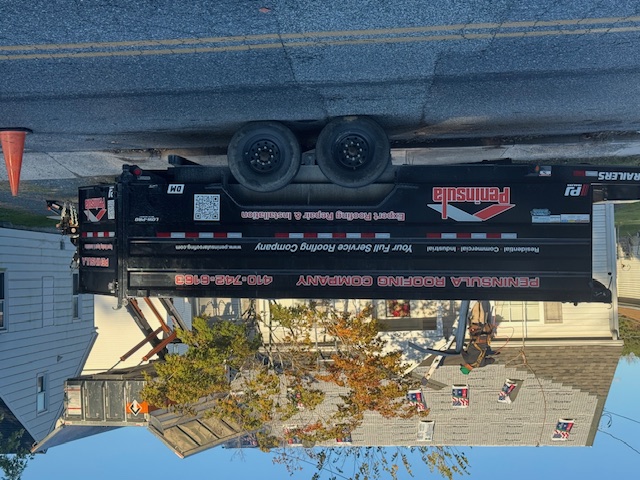
We don’t just nail over the dust. Our crews are trained to ensure the surface is prepared correctly. Usually, a quick blow-off with a high-powered leaf blower or a manual wipe-down of the critical areas is all it takes to clear the path for the adhesive. We make sure that when those shingles go down, they stay down, regardless of how much pine or oak pollen is in the air that day.
The “Slippery Slope” (Literally)
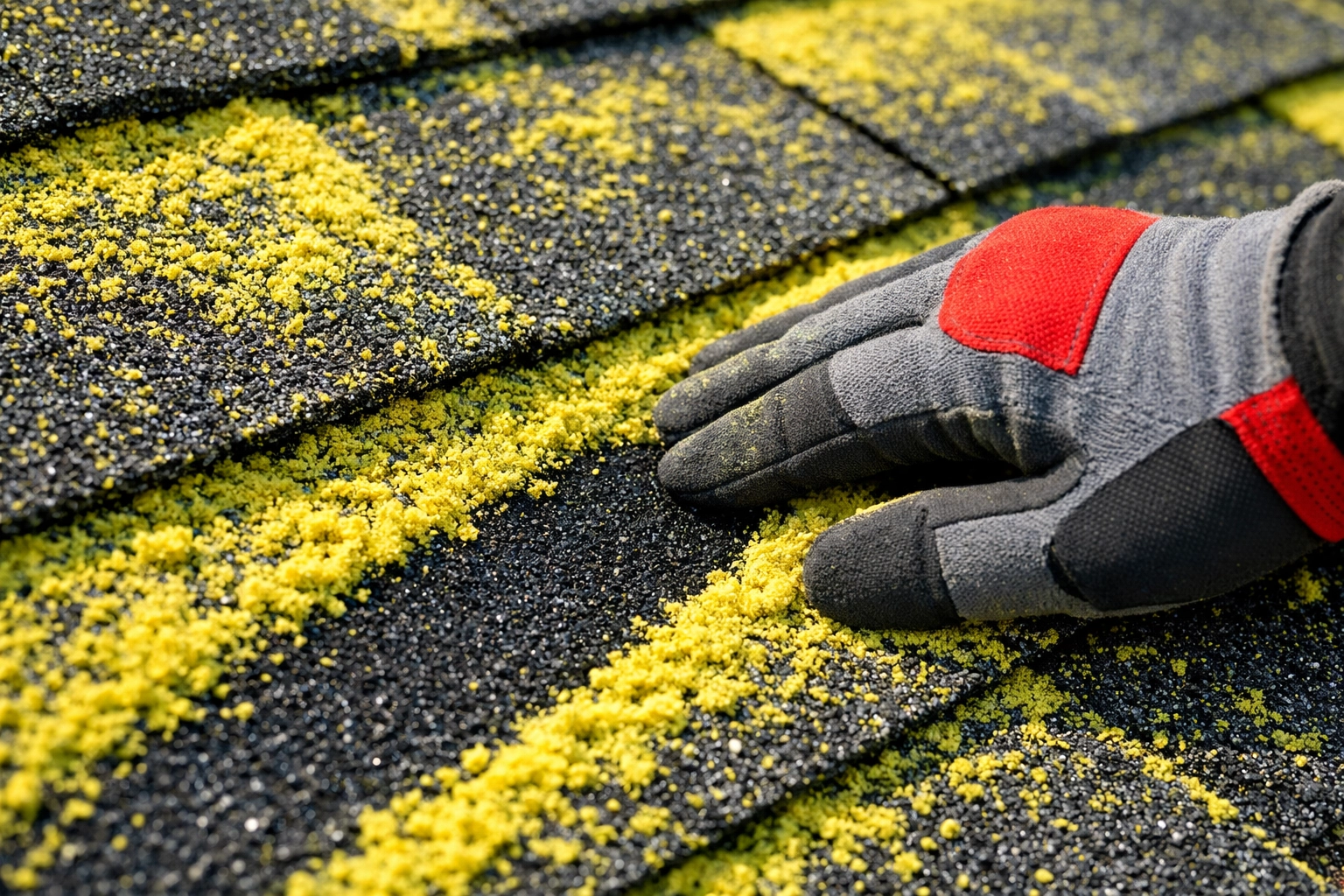
There is also a major safety component to pollen that most homeowners don’t consider. When pollen gets wet from a light morning drizzle or high humidity, it turns into a slick, soapy sludge. For a roofing technician, this makes the roof incredibly dangerous.
A roof that would normally be easy to walk on becomes a “slip-and-slide” when coated in wet pollen. This is why you might see our teams wait an extra hour or two in the morning for the sun to fully dry out the surface before we begin work during the height of the season. Safety is our priority, both for our workers and for your property.
Pollen Sludge in the Gutters
Pollen doesn’t just sit on the shingles; it eventually washes down into the gutters. When it mixes with water and other debris like pine needles or maple “helicopters,” it creates a thick, paste-like sludge. This sludge is much heavier than normal leaf litter and can quickly clog downspouts.
If your gutters are clogged with pollen-paste, water can back up under your shingles or overflow and damage your fascia boards. Part of a healthy spring maintenance routine should always include a thorough gutter cleaning once the “yellow season” has passed.
Our “Repair First” Philosophy
At Peninsula Roofing Company, Inc., we’ve been serving the Delmarva area since 1947. Over those decades, we’ve developed a “repair first” philosophy. We know that a roof covered in yellow dust or even a few black streaks doesn’t necessarily mean you need to spend thousands on a full replacement.
In many cases, a professional cleaning or a targeted repair can extend the life of your roof by years. If the pollen has led to a small moss outbreak or a clogged valley, we can fix those specific issues without recommending a whole new roof unless it’s truly necessary. We believe in being honest with our Salisbury neighbors: if it can be fixed, we’ll tell you.
You can learn more about our approach on our About Us page.
What Can You Do?
So, should you be out there with a garden hose trying to wash your roof every day in April? Probably not. Using a high-pressure power washer on asphalt shingles is a recipe for disaster: it will strip away the protective granules and leave your roof vulnerable to UV damage.
Here are a few professional tips for managing pollen season in Salisbury, MD:
- Wait for the Wash: Usually, a heavy spring rain will do a decent job of rinsing the bulk of the pollen off your roof.
- Monitor the Streaks: After the pollen season ends, take a look at your roof. If you see black streaks or green moss patches starting to form, it’s time to call in a pro for a roof inspection.
- Clean Your Gutters: Once the trees are done doing their thing, make sure your gutters are clear of that sticky yellow sludge.
- Trim the Overhang: Trees that hang directly over your roof drop significantly more pollen and debris. Keeping branches trimmed back at least 6 to 10 feet from the roof line can help minimize accumulation.
Need a Professional Eye?
Pollen is a part of life here on the Eastern Shore, but it shouldn’t be the reason your roof fails prematurely. Whether you’re worried about adhesion on a new project or you’re seeing the effects of biological growth from seasons past, we’re here to help.
If you’re concerned about the state of your roof or if you’re ready to schedule an installation that’s “pollen-proofed,” reach out to us at Peninsula Roofing. We’ll give you a straight answer and a fair price.
Contact the experts at Peninsula Roofing Company, Inc. today:
Request a Quote or Service
Don’t let the “yellow dust” get you down. With a little maintenance and the right team behind you, your Salisbury home will be ready for whatever the Delmarva weather throws at it next!