
In the world of commercial roofing, we usually treat ponding water as the ultimate villain. It’s the slow-motion disaster that rots membranes, attracts mosquitos, and eventually forces a structural collapse. But every now and then, we run into a situation so technically backwards that it makes even our most seasoned guys do a double-take.
We recently looked at a project that defines the word “ironic.” It’s a roof that is barely two years old, yet if you stepped onto it without seeing the permit date, you’d swear it had been baking in the Maryland sun since the early 2000s. It is a mess of standing water, degrading material, and: here is the kicker: a complete failure of the fastening system.
This roof is a “failure holding a failure in place.” The only reason the entire system hasn’t peeled off and landed in the middle of a Salisbury street is likely the sheer, crushing weight of the water sitting on top of it. It’s a dangerous paradox, and it’s exactly why cutting corners on specialty decks like gypsum is a gamble you’ll never win.
The 2-Year-Old Roof That Looks 15
When we talk about “ponding water,” we aren’t just talking about a few damp spots after a morning shower. In the roofing industry, ponding is defined as water that remains on a roof for 48 hours or longer after precipitation has stopped. On this specific building, we aren’t looking at puddles; we’re looking at a lake.
Because this roof was poorly designed or the deck has already begun to deflect, the water has nowhere to go. This constant submersion acts like a time machine for roofing materials. A standard TPO or EPDM membrane is designed to shed water, not live underwater. When a roof stays submerged, the UV rays from the sun are actually intensified through the water (like a magnifying glass), and the chemical bonds in the membrane begin to break down at an exponential rate.
This is why a two-year-old roof currently looks like it’s lived through fifteen years of abuse. The edges are curling, the surface is chalking, and the seams are under constant hydrostatic pressure. But the real story isn’t just what’s happening on the surface: it’s what’s happening (or not happening) underneath.
The Gypsum Deck: A Diva of a Substrate
To understand why this roof is such a disaster, you have to understand the deck. This building uses a gypsum deck. For those who don’t spend their lives on top of commercial buildings, gypsum decking is a specialty material often found in older Salisbury schools, warehouses, and offices. It’s prized for its fire resistance, but it is incredibly temperamental.
Gypsum is essentially a mixture of gypsum and wood fibers. When it’s dry and properly maintained, it’s a solid, non-combustible base. However, it’s also brittle. You can’t just use a standard steel deck screw or a wood fastener and expect it to hold.
At Peninsula Roofing, we often describe fastening into gypsum like “sticking a toothpick into a cupcake.” If you use the wrong hardware, it might feel like it’s grabbing at first, but the moment any tension is applied, the gypsum crumbles, the hole strips out, and the fastener loses all its “withdrawal value.”
On this specific roof, the wrong fasteners were used. Instead of specialized high-thread or toggle-style fasteners designed specifically to grip the brittle gypsum matrix, the original installers used standard hardware. They basically poked thousands of holes in a cupcake and hoped for the best.
The Irony: Gravity vs. Uplift
So, if the fasteners are essentially useless and have no “bite” into the deck, why hasn’t the roof blown off yet? This is where the irony sets in.
Normally, a roof stays attached to a building through mechanical attachment (fasteners) or adhesives. When the wind blows over a flat roof, it creates “uplift”: a vacuum effect that tries to suck the roof off the building. Proper fastening is usually what prevents roof blow-offs in the first place. A correctly attached system has the withdrawal strength and perimeter security to stay put when wind starts pulling at the edges and corners. If your fasteners are “toothpicks in a cupcake,” the wind should have made short work of this roof during the first Delmarva storm.
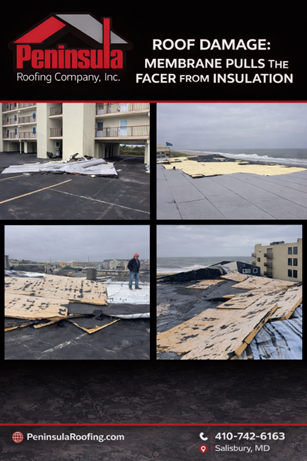
In most roof blow-off situations, failed attachment is the story. On this roof, the strange twist is that water weight is doing the heavy lifting and helping keep the system in place, at least for now.
But this roof is carrying thousands of gallons of ponding water.
One inch of water weighs approximately 5.2 pounds per square foot. If you have a large commercial roof with several inches of ponding water, you are talking about tens of thousands of pounds of downward pressure. In a bizarre twist of physics, the weight of the water: the very thing destroying the membrane: is acting as a ballast. It is pinning the failing membrane to the failing deck, counteracting the wind uplift that would have otherwise peeled the roof back like a sardine can.
It is a precarious balance. You have a “failure” (the ponding water) preventing the catastrophic manifestation of another “failure” (the wrong fasteners).
Why This Is a Ticking Time Bomb
While it might seem “lucky” that the roof is still there, this is an incredibly dangerous situation. There are three major reasons why the “water weight” solution is actually a nightmare scenario:
1. Structural Overload
Roofs are designed to carry a specific “dead load” (the weight of the materials) and “live load” (temporary weight like snow or workers). Most commercial decks are not designed to hold 5 to 10 inches of standing water indefinitely. As the water sits, the gypsum deck can begin to sag or “deflect.” This creates a deeper bowl, which collects more water, which increases the weight, which increases the sag. Eventually, you aren’t just looking at a roof replacement; you’re looking at a structural collapse.
2. The Multiplier Effect of Fastener Corrosion
Because the fasteners are wrong and the water is ponding, moisture is almost certainly migrating into the gypsum deck. When gypsum gets wet, it loses its structural integrity. It turns from a “cupcake” into “mush.” Furthermore, the wrong fasteners usually don’t have the high-end corrosion-resistant coatings required for these environments. The water sitting above is slowly eating away at the very hardware that is already failing to hold.
3. The “Unzipping” Effect
If we were to get a significant wind event: like a hurricane or a severe Nor’easter: the wind could eventually overcome the weight of that water at the corners or perimeters. Once the wind gets under the edge of a roof where the fasteners have no grip, it “unzips” the entire system. At that point, you have a massive, heavy, water-soaked membrane flying through the air. That isn’t just a roof failure; that’s a liability nightmare.
The Peninsula Roofing Approach: 75 Years of Doing It Right
Sean, situations like this are why we emphasize expertise over the lowest bid. At Peninsula Roofing Company, Inc., we’ve been serving the Delmarva area since 1947. Over 75 years, we’ve seen every type of deck imaginable, and we know that gypsum requires a specific touch.
When we encounter a gypsum deck, we don’t guess. We perform pull tests. This involves using a calibrated machine to physically pull fasteners out of the deck to see exactly how many pounds of pressure they can withstand. If the deck is too soft or the pull values are too low, we don’t just “wing it.” We find a different engineering solution, whether that’s a different fastening system or a completely different attachment method.
We also prioritize drainage. A roof is a system, not just a cover. If you have ponding water, it means your drainage system is failing. Whether it’s through the use of tapered insulation to create artificial slopes or the installation of new drains and scuppers, we ensure that water moves off the roof as quickly as possible.

A properly installed commercial roof should be dry, sloped, and securely fastened, regardless of the deck type.
Fixing the Irony
If you own a building with a flat roof that looks more like a swimming pool, don’t take comfort in the weight of the water. You are looking at a structural and financial disaster in the making.
The fix for a “failure holding a failure” isn’t simple, but it is necessary. It involves:
- A Professional Assessment: We need to get up there and see what we’re dealing with. Is the deck still salvageable?
- Fastener Verification: We check to see if the current attachment meets manufacturer and building code requirements.
- Drainage Correction: We solve the ponding issue so the membrane can actually live out its intended lifespan.
- Specialized Solutions: For gypsum, we use the right “bite”: hardware designed to stay put even when the wind gets moving.
Don’t wait for the water to stop being the only thing holding your roof down. If your roof is two years old but looks like it’s seen better decades, give us a call at 410-742-6163 or visit our contact page. We’ve been the trusted experts in Salisbury, MD, since the 40s for a reason: we know the difference between a cupcake and a roof deck.
Our team knows how to handle complex commercial decks like gypsum to ensure your roof stays exactly where it belongs.
The irony of a ponding roof is a story we see too often, but it’s a story that always ends the same way if it isn’t corrected: with a very expensive phone call. Let’s make sure your roof is held down by engineering, not just gravity. Reach out to Peninsula Roofing Company, Inc. today to schedule a comprehensive inspection.