

When you look at a commercial building in Salisbury, MD, you see the finished product: the clean lines of the membrane, the flashings, and the drainage systems. But as any seasoned roofer will tell you, a roof is only as good as the deck it’s sitting on.
In many of our older commercial and industrial buildings across the Delmarva Peninsula, that deck isn’t steel or wood: it’s gypsum.
Gypsum decking is a bit of a “hidden” variable in the roofing industry. If you know what you’re doing, it’s a reliable, fire-resistant substrate that can last for decades. If you don’t? It becomes a ticking time bomb. At Peninsula Roofing Company, Inc., we’ve spent over 75 years navigating these technical challenges. Here is why the “Gypsum Gamble” is one you shouldn’t take without the right expertise and, most importantly, the right fasteners.
What is Gypsum Decking?
To understand the fastener problem, you first have to understand the material. Gypsum decking is a specialty substrate often found in older commercial buildings in Salisbury, MD, and surrounding areas. It was particularly popular in the mid-20th century because of its incredible fire-retardant properties.
Think of gypsum decking as the “sourdough bread” of the roofing world. It is a mixture of gypsum (a soft sulfate mineral) and wood fibers. In some cases, it was poured in place over formboards to create a solid, monolithic slab. In others, it was installed as pre-cast panels.
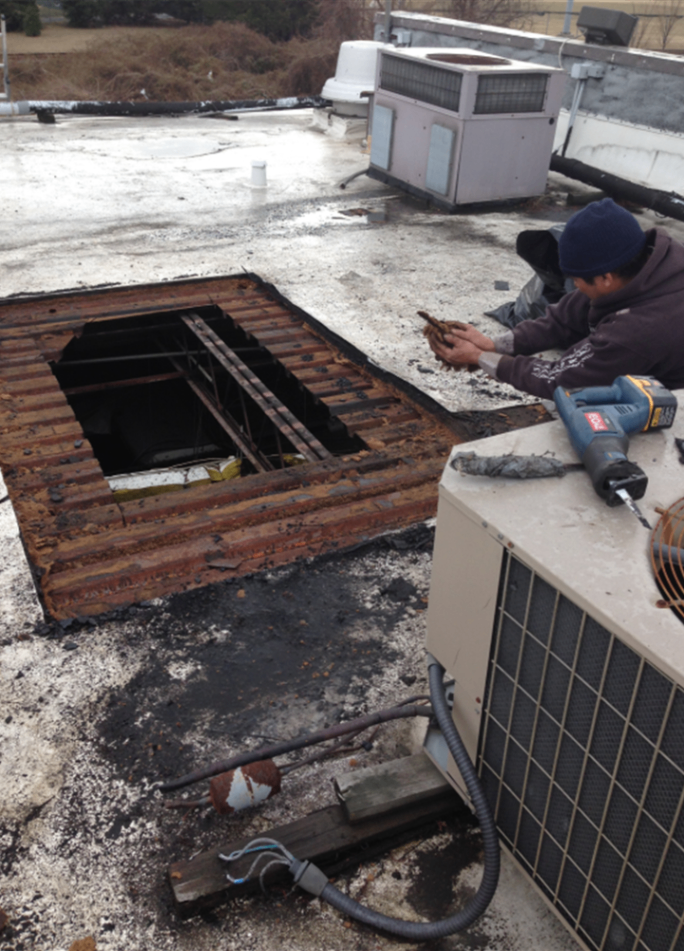
While it looks solid and feels heavy, it is fundamentally different from wood or concrete. It is brittle. It’s essentially a compressed, hardened paste. While this makes it excellent at stopping a fire from spreading through a roof assembly, it creates a unique challenge: it has very little “shear” strength and can be easily pulverized if you use the wrong tools.
The Fastener Dilemma: Why Standard Screws Fail
When we install a new roof membrane: whether it’s TPO, EPDM, or a modified bitumen system: we have to anchor that membrane and the underlying insulation to the deck. On a steel deck, we use heavy-duty drill-point screws. On wood, we use standard deck screws.
If you try to use those same fasteners on a gypsum deck, you’re headed for disaster.
Because gypsum is brittle and fibrous, a standard screw doesn’t “bite” into the material. Instead, it acts like a drill bit, pulverizing the gypsum into a fine powder as it turns. By the time the screw is flush, the hole it created is larger than the threads of the screw. It might feel snug for a minute, but it has zero “pull-out” resistance. It’s like trying to secure a shelf into a wall made of dry cake: it just isn’t going to hold.
Specialized Solutions: Gyptec and Tube-Loc
To properly secure a roof to a gypsum deck, you need specialized hardware designed to distribute the load without shattering the substrate. At Peninsula Roofing, we typically look toward two main solutions:
1. Gyptec Fasteners
Gyptec fasteners are designed specifically for “low-density” decks like gypsum and glass-fiber reinforced concrete. These fasteners have a very deep, wide-thread design. Instead of cutting through the material, they “grip” into the fibers of the gypsum. They are often coated to prevent corrosion, which is vital because gypsum can hold moisture if the roof has leaked in the past.
2. Tube-Loc Systems
The Tube-Loc system is another favorite for these types of decks. This system uses a hollow tube that is inserted into a pre-drilled hole. A fastener is then driven through the tube, which expands the base or creates a mechanical “lock” against the underside or within the core of the deck. This ensures that the uplift pressure of the wind is distributed across a larger surface area of the gypsum, preventing the fastener from simply pulling out.

The Science of the Pull Test
How do we know which fastener to use? We don’t guess. We test.
Before we even provide a final quote for a gypsum deck project, we perform what’s known as a Pull Test. This is a non-negotiable step in our services. We go up on the roof, drill a series of test fasteners into different sections of the deck, and use a calibrated hydraulic pull machine to see exactly how many pounds of force it takes to rip that fastener out.
Why is this essential? Because gypsum is sensitive to moisture. If a building has had a slow leak for five years, the gypsum deck might look fine from the top, but the core could be soft and “mushy.” A pull test tells us if the deck is still structurally sound enough to hold a new roof. If the fasteners pull out at 100 lbs of force but the wind uplift requirements for Salisbury, MD require 300 lbs, we have to rethink the entire system: perhaps moving to a ballasted or fully adhered system instead of a mechanically attached one.
What Happens if You Use the Wrong Fastener?
The consequences of getting this wrong aren’t just “annoying”: they are catastrophic and expensive.
1. The “Flyaway” Roof (Wind Uplift)
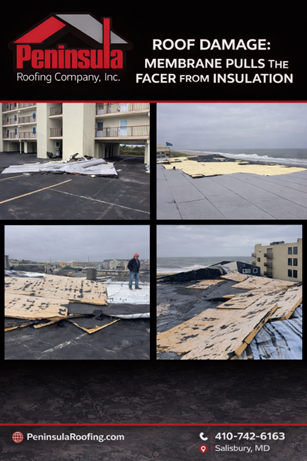
A roof membrane acts like a giant wing. When high winds blow over your building, they create a vacuum that tries to suck the roof off. If you’ve used standard screws in a gypsum deck, those screws will pull right out of the “cake-like” material. We’ve seen entire roof sections peel back like a sardine can lid during storms because the previous contractor used the wrong fasteners.
2. Crumbling the Deck
Using an aggressive, vibrating drill or the wrong screw thread can cause the gypsum to crack and crumble. Once the integrity of the deck is compromised, you lose the flat, level surface needed for your insulation. Over time, you’ll see “dips” and “divots” in your roof where the deck has essentially turned to dust underneath the membrane.
3. Voided Warranties
Major roofing manufacturers like GAF, Carlisle, or Firestone will not warrant a roof if it wasn’t installed according to their specific fastener patterns and requirements. If we don’t use an approved Gyptec or Tube-Loc fastener, and your roof fails, the manufacturer will walk away, leaving you with a massive bill.
4. Lost Fire Ratings
Gypsum decks are often chosen to meet specific fire codes. By using unapproved fasteners or damaging the deck during installation, you can technically void the assembly’s fire rating. In the event of a fire, this could lead to insurance complications and increased safety risks for the building occupants.
The Peninsula Roofing Advantage
Dealing with gypsum is a technical challenge that requires a steady hand and a lot of history. Since 1947, Peninsula Roofing Company, Inc. has been the “go-to” for commercial roofing in Salisbury. We’ve seen the evolution of these decks firsthand.
When you work with us, you’re not just getting a crew with a nail gun. You’re getting a team that understands the chemistry of your deck. We know how to spot a poured gypsum deck versus a plank deck. We know the exact torque settings to use so we don’t “over-drive” a fastener and strip the hole. Most importantly, we have the specialized equipment to perform the necessary pull tests to ensure your building is safe.
Don’t Gamble with Your Substrate
If you own or manage a commercial property in Salisbury, MD, and you aren’t sure what kind of deck you have, it’s time for a professional evaluation. Don’t let a “low-bid” contractor treat your gypsum deck like it’s a standard piece of plywood. The fasteners might be a small part of the budget, but they are the only thing keeping your roof on the building when the wind starts to howl.
Curious about the health of your roof deck? Contact us today to schedule a professional inspection and pull test. At Peninsula Roofing, we believe in doing it right the first time: because after 75 years, our reputation is just as solid as the roofs we build.
For more information about our history and our commitment to the Salisbury community, visit our About Us page.