

For commercial property owners in Salisbury, MD, and across the Delmarva Peninsula, maintaining a large-scale facility is a game of strategy. When a flat or low-slope roof begins to show its age, the question isn’t always “When do we replace it?” but rather “How can we extend its life?”
As we’ve discussed with many of our long-term clients at Peninsula Roofing Company, Inc., the market is flooded with products claiming to be a “roof in a can.” While roof coatings are an incredible tool for asset management, they are not a one-size-fits-all solution. Choosing the wrong chemistry for your specific roof type can lead to wasted capital, or worse, accelerated roof failure.
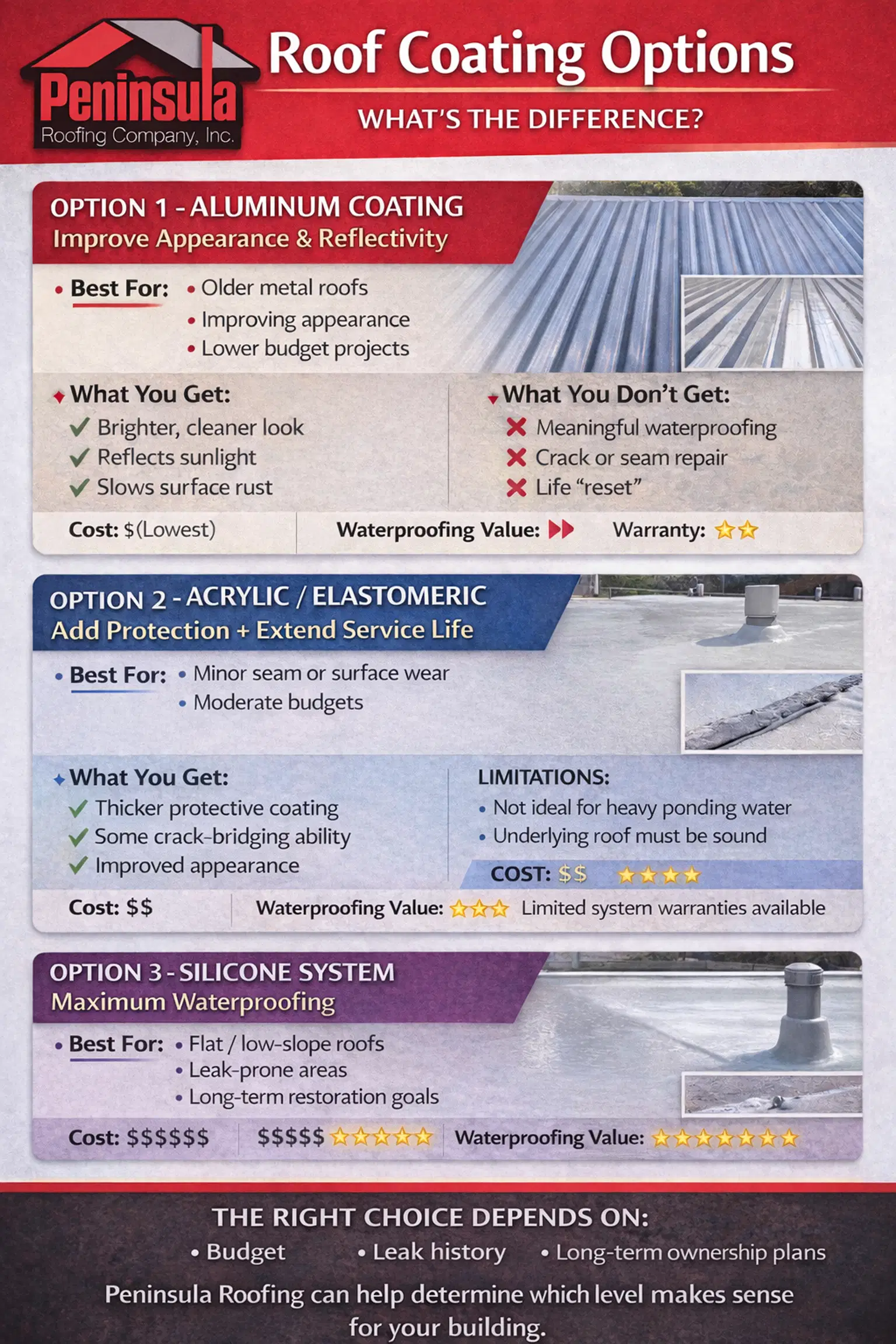
With over 75 years of experience serving the Salisbury community, we’ve seen every type of coating application imaginable. To help you make an informed decision for your facility, let’s break down the three standard coating types: Aluminum, Acrylic, and Silicone: and look at where they excel and where they fall short.
1. Aluminum Coatings: The Reflectivity Specialist
Aluminum roof coatings are among the oldest technologies in the industry. These are typically solvent-based and contain leafing aluminum pigments. When applied, the aluminum flakes float to the surface to create a reflective metallic finish.
Best Use Cases
Aluminum coatings are primarily designed for asphaltic built-up roofs (BUR) and modified bitumen systems. Their main job is to protect the underlying asphalt from UV degradation. By reflecting the sun’s rays, the coating keeps the roof surface cooler, which prevents the asphalt from becoming brittle and cracking over time.
The Trade-offs
The biggest misconception about aluminum coating is that it is a waterproofing agent. It is not. Think of aluminum as a reflectivity/UV shield, not a watertight membrane. Aluminum coatings provide virtually no true waterproofing capability on their own. If your roof has active leaks, an aluminum coating will not reliably seal them (that typically requires targeted repairs, reinforcing fabrics, or a different system altogether). Furthermore, while it restores reflectivity, it does nothing to reinforce the structure of the roof.
At a glance:
- Pros: Cost-effective, excellent UV reflectivity, extends the life of asphalt membranes.
- Cons: Reflectivity-focused (not waterproofing), doesn’t handle ponding water, purely protective against UV—not a “reset” for roof condition.
2. Acrylic/Elastomeric Coatings: The Metal-Roof Favorite (With a Ponding Problem)
Acrylic coatings are water-based (aqueous) systems that have gained popularity because they are easy to apply and environmentally friendly. When people talk about “cool roofs,” they are often referring to white acrylic elastomeric coatings.
Best Use Cases
Acrylics are excellent for restoring the appearance of sloped metal roofs. Because they are highly elastic, they can expand and contract along with the metal panels as temperatures shift throughout the day in our Salisbury climate. They can provide legitimate surface protection and improved reflectivity for metal systems—especially when the roof has good drainage and the details (fasteners, seams, penetrations) are properly addressed.
The Weakness: Ponding Water
The Achilles’ heel of acrylic coating is ponding water. Because it is a water-based product, it can undergo “re-emulsification” if it is submerged in water for too long. In plain English: if your roof has flat spots where water sits for 48 hours or more (ponding water), an acrylic coating can soften over time, blister, and peel away.
That’s why acrylic is commonly a better fit for metal roofs and positive-slope surfaces, and why it’s risky as a “solution” on truly flat commercial roofs across Delmarva where heavy rains, humidity, and imperfect drainage are common.
At a glance:
- Pros: Highly reflective, a strong option for metal roofs, environmentally friendly (low VOC).
- Cons: Can fail under ponding water, may require multiple coats, loses thickness over time due to weathering.
3. Silicone Systems: The Performance Heavyweight
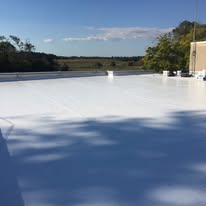
When a property owner in Salisbury asks for the “best” standard coating, the answer is almost always silicone. Unlike acrylics, silicone is a moisture-cure substance, meaning it doesn’t just “dry”: it chemically reacts with moisture in the air to create a permanent, rubber-like membrane.
Why Silicone Wins on Performance
Silicone is the only standard coating that can truly withstand ponding water. It will not break down, even if submerged for weeks. It is also incredibly stable under UV light. While acrylics can become brittle after a decade of sun exposure, silicone remains flexible, protecting the roof from the thermal shock of our Maryland seasons.
The Cost-Benefit Reality Check
However, there is a catch that we always disclose to our clients. A high-quality silicone system is not a cheap fix. To be applied correctly, the roof must be meticulously cleaned, primed (when required), detailed at seams/penetrations, and coated at a high mil thickness.
In many cases, a properly applied silicone system can cost up to 80% of the price of a single-ply (TPO or PVC) recover.
The Insurance and Warranty Gap (Coating Doesn’t Always “Reset the Clock”)
This is where property managers need to be careful. A silicone coating can be an excellent restoration option, but many insurance carriers (and some warranty/asset tracking frameworks) still consider the roof’s “age” to be the age of the underlying roof system, not the day it was coated.
- Warranty: A silicone coating typically comes with a manufacturer’s coating warranty (often material and sometimes labor, depending on the system), but it rarely matches the scope and long-term value of an NDL warranty on a full single-ply system.
- Insurance/Asset Life: Even after coating, you may not get credit for a “new roof” in underwriting. In other words, a coating often doesn’t reset the clock for insurance purposes—so you can still see premium pressure, coverage limitations, or higher deductibles if the underlying roof assembly is older (for example, 20+ years).
If you are spending 80% of the cost of a new roof, it is often worth the extra 20% to get a full commercial roofing service that can reset warranty coverage and asset life more cleanly.
4. Specialized Coatings: For Unique Challenges
Beyond the big three, there are specialized coatings designed for “special circumstances.”
- Urethane Coatings: These are much tougher than silicone or acrylic. We recommend these for roofs that see high foot traffic: such as roofs with heavy HVAC maintenance schedules or hospitality decks. Urethanes are more resistant to impact and abrasion (like tools being dropped or debris being blown around).
- PMMA/PMA (Liquid Flashing): These are high-performance resins used for complex penetrations where traditional flashing might fail. They are expensive but nearly indestructible.
Making the Right Choice for Your Salisbury Property
So, which one is right for you? It depends entirely on your goals:
- Are you just trying to lower your energy bill on an older BUR roof? Aluminum might be your answer.
- Do you have a sloped metal roof that looks dingy and has minor pinhole leaks? Acrylic is a great, cost-effective aesthetic and protective choice.
- Do you have a flat roof with minor ponding and you want the best protection possible without a full tear-off? Silicone is the way to go, provided the price point makes sense compared to a recover.
At Peninsula Roofing Company, Inc., we’ve been navigating these choices since 1947. We don’t believe in selling a coating just to put a “band-aid” on a problem. Our team performs a comprehensive assessment to ensure the underlying insulation is dry and the structure is sound before we ever open a bucket of coating.
If you’re unsure which direction to take your commercial property, contact us today for a professional inspection. We’ll help you weigh the ROI of a coating system versus a full recovery so you can make the best decision for your bottom line.
Whether it’s a silicone restoration or a new TPO membrane, the experts at Peninsula Roofing Company, Inc. have the Salisbury community covered. Visit our About Us page to learn more about our 75-year legacy of quality on the Delmarva Peninsula.