

If you’ve lived through a July in Salisbury, MD, you know exactly what we’re talking about when we say the air feels like a warm, wet blanket. That humidity isn’t just hard on your hair and your air conditioning bill; it is absolutely brutal on your roof.
When most homeowners think about their roof, they think about shingles, gutters, and maybe the occasional rogue branch after a storm. But there is an entire world happening underneath those shingles, in your attic, that dictates exactly how long that roof is going to last. We’re talking about ventilation.
At Peninsula Roofing Company, Inc., we’ve seen plenty of roofs that looked great from the curb but were literally rotting from the inside out because they couldn’t “breathe.” If you’re looking at roofing companies in Salisbury, MD to handle a replacement or a repair, one of the first questions you should ask is: “How are you going to vent this thing?”
Why Does My Roof Need to Breathe?
It sounds a bit strange to talk about a “breathable” roof. After all, the whole point of a roof is to be a sealed barrier against the rain, right? Well, while we want to keep the water out, we definitely don’t want to trap the air in.
Proper ventilation serves three main purposes in a Salisbury home:
- Heat Reduction: In the summer, the sun beats down on your asphalt shingles. Without a way for that heat to escape, your attic can easily reach 150 degrees or more. That heat eventually migrates down into your living space, making your AC work overtime.
- Moisture Control: This is the big one for the Eastern Shore. Every time you shower, boil pasta, or run the dishwasher, warm, moist air rises. If it gets trapped in your attic during the winter, it hits the cold underside of your roof deck, turns into condensation, and starts growing mold or rotting your rafters.
- Extending Shingle Life: Asphalt shingles are tough, but they aren’t invincible. If they are getting “baked” from both sides, the sun above and a furnace-like attic below, they will curl, crack, and lose their granules much faster than they should. In fact, most shingle manufacturers will actually void your warranty if they find out the roof wasn’t properly ventilated.

The Magic Number: The 1/300 Rule
When you talk to professional Salisbury roofers, you might hear them mention the “1/300 rule.” This is the industry standard and a common building code requirement.
Essentially, the rule states that for every 300 square feet of attic floor space, you need at least 1 square foot of “net free ventilating area.” Half of that should be for intake (air coming in), and half should be for exhaust (air going out).
If your attic is 1,200 square feet, you need 4 square feet of total ventilation. It sounds simple, but getting that balance right is where the expertise of roofers in Salisbury, MD really comes into play. If you have too much intake and not enough exhaust (or vice versa), the system won’t “draw” the air through correctly, leaving stagnant pockets of hot, wet air in the corners of your attic.
It’s a Two-Way Street: The Balanced System
Ventilation isn’t just a hole in the roof; it’s a system. Think of it like a chimney. A chimney doesn’t work unless there is a place for air to enter the fireplace and a place for smoke to leave the top. Your attic is the same way.
The Intake (The Inhale)
Air usually enters the attic through the eaves. The most common way to do this is with soffit vents. These are the perforated panels you see underneath your roof’s overhang.
If your home doesn’t have much of an overhang, we might use a drip edge vent or “smart vents” that sit right at the edge of the roofline. The goal is to pull cool, fresh air from the lowest point of the roof.
The Exhaust (The Exhale)
As the cool air enters the bottom, it pushes the warmer air up and out through the top. This is the “exhaust” part of the system. This is where most people start looking at different hardware options.
Is a Ridge Vent the Only Solution?
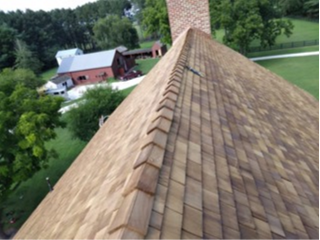
A lot of people think that a ridge vent is the “end-all, be-all” of roofing. While ridge vents are fantastic because they run along the entire peak of the roof and are very low-profile, they aren’t always the right choice for every house.
Depending on the shape of your roof, especially if you have a lot of hips and valleys or a very short ridge line, a ridge vent might not provide enough “net free area” to meet that 1/300 rule. Here are the other tools in our kit:
- Box Vents (Louvers): These are the square vents you see sitting near the top of the roof. They don’t have moving parts and rely entirely on natural convection. They are great for roofs with complex shapes where a continuous ridge vent isn’t possible.
- Turbines (Whirlybirds): You’ve seen these, they look like little mushrooms that spin in the wind. They are actually very effective at pulling air out of an attic, but some homeowners don’t like the “industrial” look of them.
- Power Vents: These are motorized fans that sit on the roof. They can move a massive amount of air very quickly.
- Gable Vents: These are the vents located on the vertical walls at the ends of a peaked roof. While they are a classic look for Salisbury homes, they often struggle to vent the middle of a large attic on their own.
The Secret Weapon: Attic Fans with Humidistats
If you really want to protect your home from the Maryland humidity, we need to talk about power fans. But not just any fan, a fan equipped with a humidistat.
Most people understand the concept of a thermostat. When the attic hits 100 degrees, the fan kicks on. That’s great for the summer. But what about a rainy, 40-degree day in November? Your attic isn’t hot, so the thermostat won’t trigger the fan. However, the humidity in the attic might be through the roof.
A humidistat measures the moisture levels in the air. If the humidity climbs above a certain percentage (usually around 60-70%), the fan turns on to flush that damp air out, even if it’s cold outside. This is one of the single best ways to prevent mold growth and “deck rot” in our local climate. When you are comparing roofing companies in Salisbury, MD, ask if they offer fans with dual controls (heat and moisture). It’s a game-changer for the longevity of your home.
Local Considerations for Salisbury Homeowners
Being near the coast means we deal with salt air and high winds. When we install ventilation systems, we have to make sure they are “weather-tight.” The last thing you want is a vent that lets in driving rain during a Nor’easter.
We also see a lot of older homes in the Salisbury area where the soffit vents have been accidentally covered up by blown-in insulation. This is a huge “no-no.” If we’re out doing an inspection, we’ll check for “baffles”: these are plastic or foam channels that keep the insulation away from the vents so the air can actually get through.
Without those baffles, your expensive ridge vent is basically just a decorative strip on your roof because there’s no intake air to push the hot air out.

Don’t Leave Your Roof Gasping for Air
Getting your ventilation right isn’t just about following building codes; it’s about protecting one of the biggest investments you’ll ever make. A well-ventilated roof stays cooler, keeps your house drier, and lasts years longer than one that’s “choking” on its own heat.
If you’re worried your attic is getting too hot, or if you’ve noticed weird spotting on your ceiling that might be condensation, it’s time for a professional look. As a trusted roofer in Salisbury, Peninsula Roofing Company, Inc. has been helping Delmarva homeowners since 1947. We don’t just “slap on shingles”: we design systems that work for our unique coastal environment.
Give us a call or check out our services page to learn more about how we can help your roof breathe easy. Whether it’s a simple ridge vent install or a high-tech power fan with a humidistat, we’ve got you covered.
Ready to see the difference a balanced system makes? Contact Peninsula Roofing Company, Inc. today for a comprehensive inspection. Let’s make sure your roof is ready for whatever the Maryland weather throws its way!