

Living in a townhome or a planned community in Salisbury, MD, offers a lot of perks: shared amenities, community spirit, and often, a lot less yard work. However, when it comes time for maintenance: specifically the kind that involves the giant structure protecting your entire investment: things can get a little tricky.
A roof replacement on a single-family home is a straightforward transaction between a homeowner and their chosen roofing contractor. But when you live in a townhome, you are walking a “townhome tightrope.” You have to balance your own home’s needs with the rules of your Homeowners Association (HOA) and the physical (and often financial) realities of your neighbors.
At Peninsula Roofing Company, Inc., we’ve been helping residents navigate these complexities for over 75 years. We’ve seen the good, the bad, and the “leaky” when it comes to multi-unit projects. If you’re staring up at your shingles and wondering how to start the conversation, here is our expert guide on managing your townhome roof replacement.
Step 1: Crack Open the CC&Rs (The “Who Pays?” Question)
Before you call a single roofer in Salisbury, you need to know who is legally responsible for the roof. In the world of HOAs, this is dictated by your Covenants, Conditions, and Restrictions (CC&Rs).
Generally, townhome roof responsibility falls into one of two categories:
- The HOA is Responsible: In many “condo-style” townhome arrangements, the exterior of the building: including the roof: is considered a “common element.” In this case, your monthly dues pay into a reserve fund that covers roof replacements. Your job is simply to report leaks and stay informed on the HOA’s maintenance schedule.
- The Homeowner is Responsible: In “fee-simple” townhomes, you likely own the land and the structure. In these communities, the roof is your responsibility. However, even if you are paying for it, the HOA still usually dictates what you can put on that roof to ensure a uniform look across the neighborhood.
Sean, we always tell our clients to double-check their documents first. Nothing is more awkward than starting a project only to find out you’re violating a community covenant or, conversely, paying for something the association should have covered.
Step 2: The “Shared Seam” Issue (Why Half a Roof is a Whole Problem)
If you are responsible for your portion of the roof, you might be tempted to just call up a company and say, “Replace my section.” On paper, this seems easy. In reality, it is a technical and aesthetic nightmare.
Townhomes are often built with one continuous roof deck spanning several units. When you replace only your portion, you create a “shared seam” where the new shingles meet the neighbor’s old shingles. This creates several major issues:
Leak Risks
The transition point between new and old materials is the most common place for a leak to occur. Old shingles are brittle and lose their granules; tying new, flexible shingles into that old surface is rarely a perfect seal. Water has a way of finding the path of least resistance, and that seam is a prime target.
Warranty Voids
Many high-quality material manufacturers are hesitant to provide full wind or water-tight warranties on “tie-ins.” If a leak develops at the seam, the manufacturer may claim it was caused by the old roof failing, while the neighbor’s insurance might claim it was the new installation’s fault. It’s a finger-pointing game that no homeowner wants to play.
Aesthetic Mismatch
Even if you find the exact same brand and color of shingle, your neighbor’s roof has been sitting in the Salisbury, MD sun for ten or fifteen years. UV rays fade shingles significantly. A “matching” new roof will almost always look like a bright patch next to a faded one, which can hurt your property value and potentially draw the ire of your HOA’s architectural committee.
Step 3: The Power of the Coordinated Replacement
The best solution to the shared seam issue is coordination. Talking to your neighbor about a joint roof replacement is one of the smartest financial moves you can make. Here is why:
Group Discounts
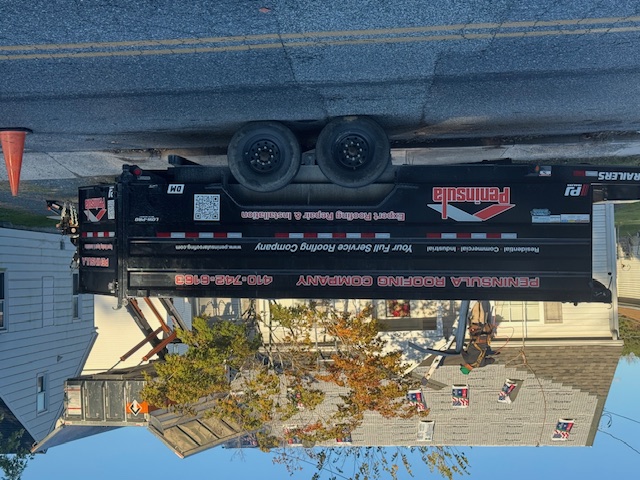
When roofing companies in Salisbury, MD can tackle two or three units at once, it saves them time and logistics. We can bring in a larger crew, share a single dumpster, and have materials delivered in bulk. Most contractors (including us!) are happy to pass those savings on to the homeowners through a “neighbor discount” or a lower per-square price.
A Unified System
By replacing the whole block at once, you eliminate the shared seam entirely. You get a single, continuous barrier of protection. This ensures that the underlayment, flashing, and shingles are all integrated perfectly, providing the best possible protection against Delmarva’s coastal storms.
Negotiating with Neighbors
If your neighbor is hesitant, focus on the “preventative” angle. Remind them that if you replace your roof and it causes a leak on their side (or vice versa), it becomes a much more expensive insurance headache. A joint consultation with a trusted Salisbury roofing expert can help put their mind at ease by providing clear, factual information about the state of the shared roof.

Step 4: Navigating HOA Approval
Unless you live in a community with no active association, you will likely need to submit a request to the Architectural Review Board (ARB) or committee. HOAs are notoriously particular about “community standards,” which usually means they want every house to look identical.
When preparing your application, be sure to include:
- The Specific Material: Are you using asphalt shingles, metal, or cedar shakes?
- The Exact Color: Most HOAs have a “pre-approved” list of colors (e.g., “Weathered Wood” or “Charcoal”).
- Contractor License and Insurance: They want to know the people on their property are professionals. Peninsula Roofing always provides our up-to-date credentials for these applications.
- Timeline: When will the work start and end?
Navigating this process can be tedious, but it’s essential. We’ve seen homeowners forced to tear off brand-new roofs because they chose a color that was “one shade too light” according to the ARB. Don’t let that be you!
Why Experience Matters in Multi-Unit Projects
Working on townhomes isn’t like working on a standalone house in the woods. There are shared driveways, narrow access points, and neighbors who might not be thrilled about the noise. You need a company that understands the logistics of working in tight quarters.
Since 1947, Peninsula Roofing Company, Inc. has been a staple of the Salisbury community. We don’t just know roofs; we know the specific neighborhoods and HOAs in the area. We understand how to protect your neighbor’s landscaping while working on your roof, and we know how to communicate with association boards to get projects approved quickly.
Whether you are part of a massive complex or a simple duplex, we bring the same level of professional service and high-quality craftsmanship that has kept us in business for over seven decades.
Ready to Cross the Tightrope?
If your townhome roof is showing signs of age: missing shingles, grit in the gutters, or those dreaded water spots on the ceiling: don’t wait for a storm to make the decision for you.
The first step is a conversation. Talk to your neighbors and see where they stand. Often, they are just as worried about the roof as you are but didn’t know how to start the process.
Give us a call at 410-742-6163 or contact us through our website to schedule a joint consultation. We can meet with you and your neighbors at the same time to explain the process, provide a transparent estimate, and help you navigate the HOA hurdles. Let’s make sure your “shared” roof is a shared success, not a shared problem.
For more information about our history and the services we provide across the Delmarva area, feel free to visit our About Us page or browse our full range of residential and commercial services. We look forward to helping you protect your home!