

If you’ve ever received a commercial roofing quote and seen “FM Approved” or “FM 1-90 Wind Rating” listed in the specs, you might have wondered what exactly that means: and why it seems to add to the price tag.
Here’s the short answer: FM Approved means your roof has been engineered and tested to survive the worst-case scenarios. It’s not just a manufacturer saying their product is good; it’s an independent, third-party insurance company proving that the entire roof assembly can handle high winds, fire, hail, and water intrusion without catastrophic failure.
For commercial property owners across Delmarva, understanding FM Global standards isn’t just about checking a box on an insurance form. It’s about knowing whether your roof will still be there after the next nor’easter rolls through Salisbury: and whether your insurance company will cover the damage if it isn’t.
Let’s break down what FM approval really means, where it came from, and why roofing companies in Salisbury MD treat it as the gold standard.
The Origin Story: A Mill Owner Who Refused to Accept “Good Enough”
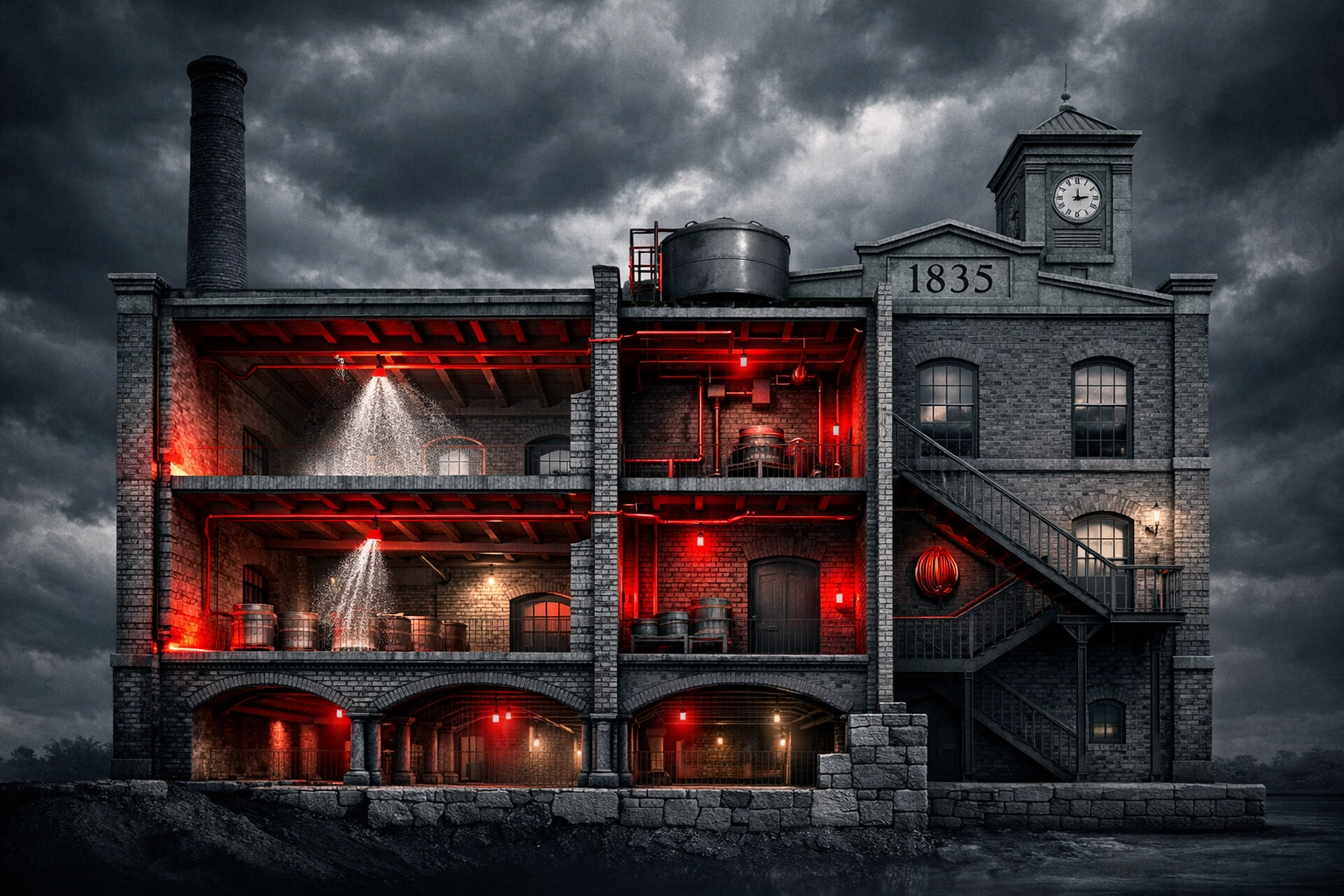
The story of FM Global begins in 1835 with a frustrated businessman named Zachariah Allen.
Allen owned a textile mill in Rhode Island, and he was obsessive about fire safety. He installed fireproof walls, automatic sprinklers (cutting-edge at the time), and strict safety protocols. His mill was, by every measure, significantly less likely to burn down than the average factory of the era.
When Allen approached his insurance company and asked for a discount on his premiums: because, you know, his building was objectively safer: they essentially laughed him out of the room. Their response? “A mill is a mill. The rate is the rate.”
Allen wasn’t the type to take that lying down. He went out, found other mill owners who cared about safety, and started his own mutual insurance company that would only insure “Highly Protected Risk” properties. The deal was simple: If you built to higher standards and maintained them, you paid lower premiums.
That company eventually became FM Global, and instead of just insuring buildings, they started engineering and testing them. If they were going to back a roof with millions of dollars in coverage, they wanted to prove it wouldn’t fail.
What Is FM Global Today?
Fast-forward to 2026, and FM Global is one of the largest commercial property insurers in the world. But unlike most insurance companies that just look at actuarial tables, FM Global operates massive testing labs where they literally try to destroy roofs.
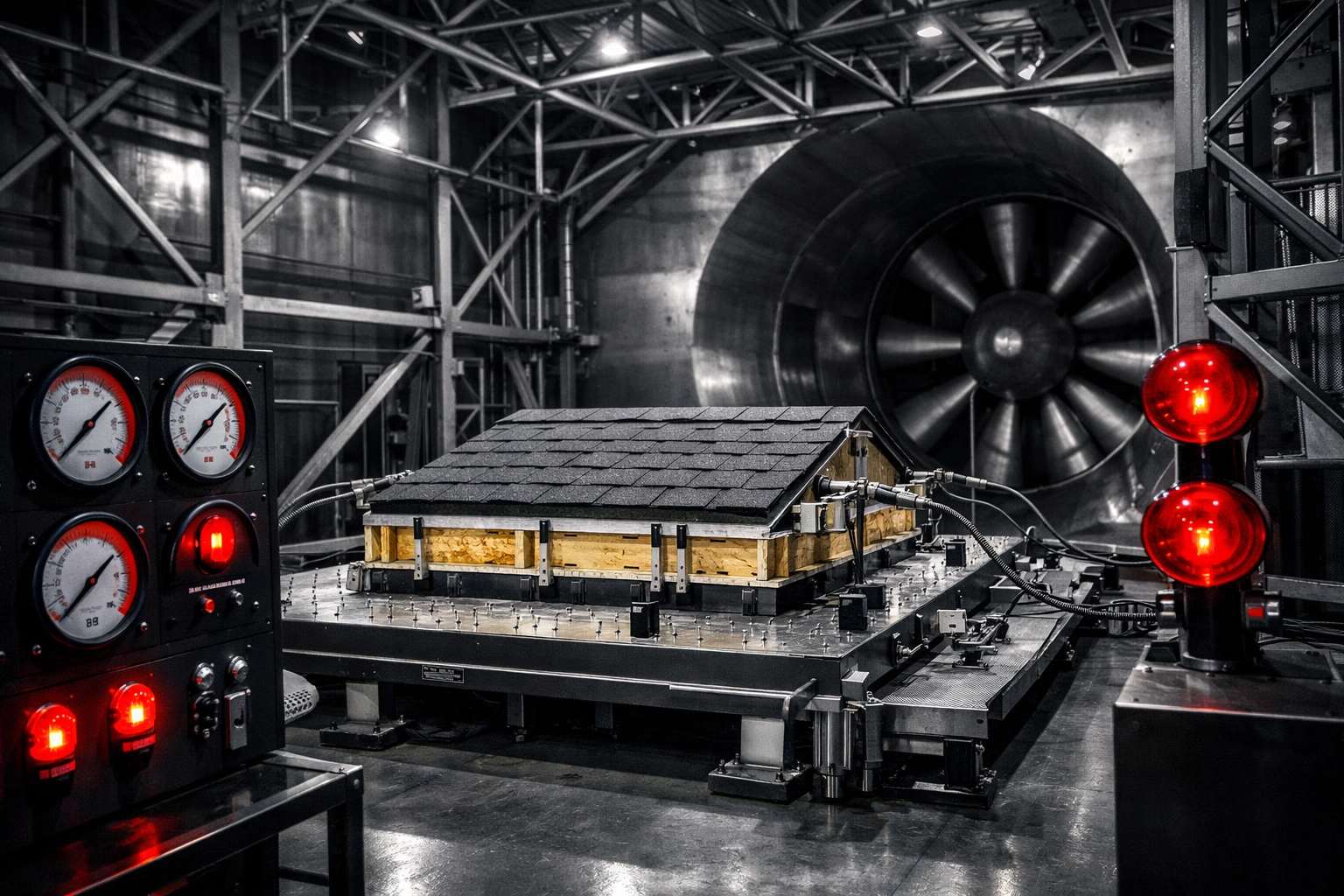
They have wind tunnels that simulate hurricane-force winds. They have machines that launch ice balls at roofing membranes to replicate hail damage. They set controlled fires to see how quickly flames spread across different materials.
When a roofing system passes their tests, it gets an FM Approval Number and is entered into their RoofNav database: a catalog of thousands of roof “recipes” that have been proven to work under specific conditions.
Here’s the key difference: FM Global doesn’t just test individual products. They test complete assemblies: the deck, the insulation, the membrane, the fasteners, and even the adhesive: all together as one integrated system.
The “Whole System” Approach: Why You Can’t Mix and Match
Think of an FM Approved roof like a recipe for bread. You can’t swap out the yeast for baking powder and expect the same result, even if both are “leavening agents.”
When FM Global tests a roof assembly, they’re testing a very specific combination of materials installed in a very specific way. If the approved assembly calls for:
- A 3-inch steel deck
- Two layers of polyiso insulation
- A 60-mil TPO membrane
- #14 screws every 6 inches
…then that’s exactly what you have to install. You can’t use a different screw, a thinner membrane, or swap the insulation brand: even if your supplier says it’s “equivalent”: because the entire FM approval is based on how those exact materials work together.
This is a big deal when you’re getting quotes from Salisbury roofers. If one contractor is quoting an FM-approved system and another is using “manufacturer-approved” materials, the FM roof will almost always cost more because there’s zero flexibility on substitutions.
Manufacturer Warranty vs. FM Approval: What’s the Difference?
This is where a lot of commercial property owners get confused. If a roofing manufacturer already offers a 20-year warranty, why do you need FM approval on top of that?
The difference comes down to what you’re being protected against.
A Manufacturer Warranty Says:
“If our product fails because of a defect in the materials: like the membrane splitting or the adhesive failing prematurely: we’ll pay to replace it.”
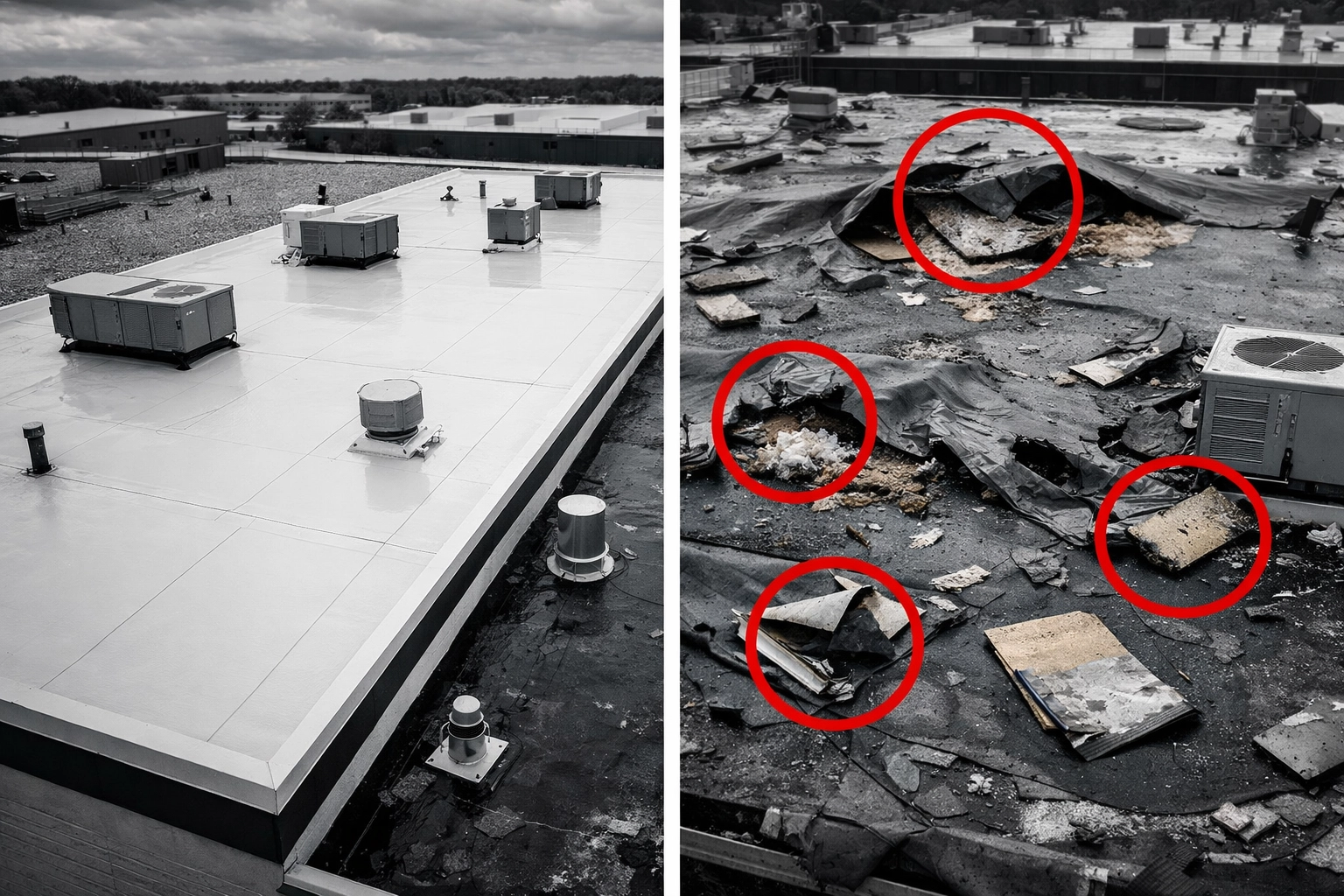
What it doesn’t cover: Storm damage, high winds ripping off the roof, or water intrusion caused by poor installation. If a hurricane peels back your membrane, the manufacturer can (and will) say, “That’s not a product defect. That’s a wind event. File a claim with your insurance.”
An FM Approval Says:
“We’ve tested this exact roof assembly in our lab, and it can withstand winds up to 90 mph (or 120 mph, depending on the rating). If it fails under those conditions, your insurance claim will be honored.”
In other words:
- Manufacturer warranty = protection against the product being bad
- FM approval = protection against the storm being bad
For property owners in coastal Maryland and Delaware, where nor’easters and tropical systems are a regular threat, that distinction matters a lot.
How FM Standards Became the Industry Standard
So how did a private insurance company’s testing protocols become the baseline for commercial roofing across the country?
It happened in three phases:
Phase 1: The “Copy-Paste” Effect
Building codes like the International Building Code (IBC) don’t operate their own testing labs. They rely on what are called “consensus standards”: research and testing done by outside organizations.
Back in the 1990s, code writers realized that FM Global had the best data in the world on why roofs fail. So instead of reinventing the wheel, the IBC started referencing FM test methods directly. For example, to prove a roof can handle wind uplift, it must be tested according to FM 4470 or FM 4450.
By writing FM standards into the legal code, FM effectively became the law: even for buildings not insured by FM Global.
Phase 2: Hurricane Andrew (1992)
When Hurricane Andrew hit South Florida, it was a wake-up call for the entire construction industry. Buildings that had been built to FM Global standards were often the only ones still standing.
Lawmakers and insurers looked at that and said, “Why aren’t we requiring everyone to build like this?” That’s when building codes across the country got significantly stricter, leaning heavily on FM’s wind uplift research.
Phase 3: The Fortune 500 Influence
Nearly every major corporation: Amazon, Walmart, FedEx: is insured by FM Global. When they build a new warehouse or distribution center, they demand FM-approved roofs.
Because these companies build so many facilities, roofing manufacturers like GAF and Carlisle started engineering all their products to pass FM tests just to stay competitive. Eventually, FM-tested assemblies became the baseline across the industry.
Why Delmarva Commercial Property Owners Should Care
If you own a commercial building in Salisbury, Ocean City, or anywhere on the Delmarva Peninsula, here’s why FM standards matter to you: even if you’re not insured by FM Global:
1. Insurance Premiums
Some commercial insurers may offer discounts for FM-rated roofs because they know the risk of catastrophic failure is lower. In some cases, having an FM 1-90 or FM 1-120 roof can save you 10–15% on your annual premium.
2. Resale Value
If you ever sell your property, having an FM-approved roof on file is a huge selling point. It tells the buyer (and their insurer) that the roof was built to the highest standards and is less likely to need emergency repairs.
3. Storm Resilience
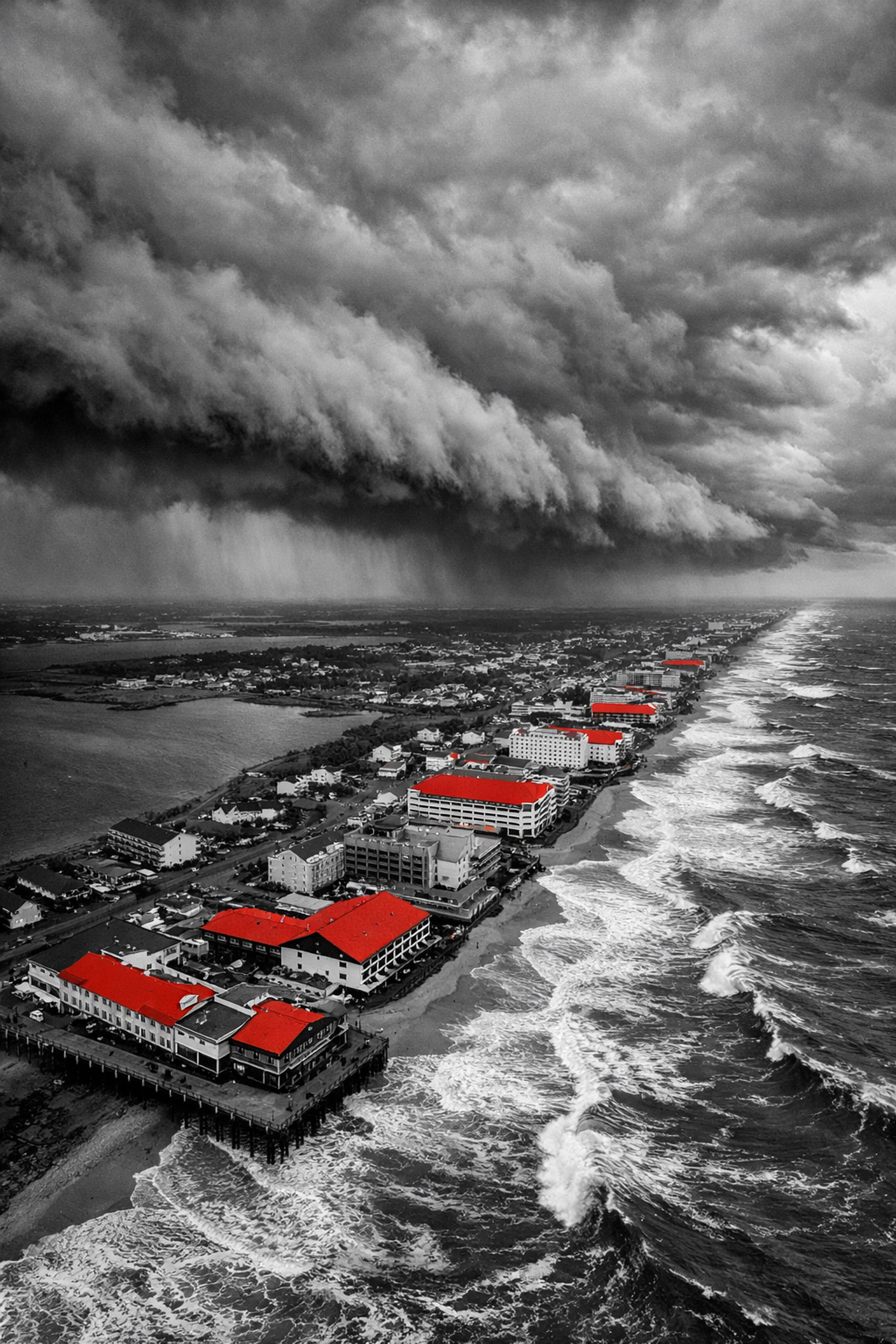
Delmarva sits in a unique weather zone. We get nor’easters from the Atlantic, tropical systems from the south, and occasional severe thunderstorms with straight-line winds. An FM 1-90 roof is specifically engineered to handle sustained winds up to 90 mph, well above what most “code-minimum” roofs are designed for.
4. Easier Claims
If you do experience storm damage, having an FM-approved roof makes the claims process significantly smoother. The insurer already knows the roof was built to a proven standard, so there’s less back-and-forth about whether the damage was caused by poor installation or an “act of God.”
What Happens During an FM Roof Installation?
If you decide to go with an FM-approved system, here’s what the process looks like:
- RoofNav Selection: Your contractor (like Peninsula Roofing Company, Inc.) logs into the FM Global RoofNav database and selects a pre-approved assembly that matches your building’s deck type, height, and wind zone.
- Material Verification: Every component: from the membrane to the screws: must match the exact specifications in the RoofNav assembly. No substitutions.
- Installation to FM Data Sheets: FM Global publishes detailed installation guidelines (called Data Sheets) for each approved assembly. Your contractor must follow these to the letter, including fastener spacing, seam overlap, and edge metal attachment.
- Inspection: Depending on your insurance policy, an FM Global engineer may visit the site during or after installation to verify compliance. If anything is off-spec, the approval is void.
- Documentation: Once complete, your contractor provides you with documentation showing the FM Approval Number, the RoofNav assembly used, and proof of compliance. This goes in your building file and gets shared with your insurer.
It’s a more rigorous process than a standard roof installation, but the result is a roof that’s been engineered to survive the worst weather Delmarva can throw at it.
The Bottom Line
An FM Approved roof isn’t just a line item on a quote: it’s a 190-year legacy of engineering, testing, and loss prevention that started with one frustrated mill owner who refused to accept “the way things are.”
For commercial property owners in Salisbury and across Delmarva, FM standards represent the difference between a roof that’s “probably fine” and a roof that’s been proven to handle high winds, fire, and water intrusion without catastrophic failure.
That said, FM is the gold standard for safety: not automatically the best financial move for every building. In many cases, an FM-compliant assembly can run 10–20% higher than a comparable, code-compliant system. If your property isn’t insured by FM Global, that added cost may not pencil out: especially since many standard insurance carriers don’t consistently offer premium discounts just because a roof meets FM standards.
So instead of treating FM as a “must-have,” we recommend treating it as a consultative choice:
- If FM Global insures your building (or your lease/ownership requirements demand FM), it’s usually non-negotiable.
- If you’re not FM-insured, the question becomes: What risk are we trying to reduce, and will your insurer (or your long-term plans) actually reward you for the upgrade?
If you’re planning a reroofing project or evaluating insurance requirements, it’s worth asking your contractor whether an FM-approved system makes sense for your building. The upfront cost may be higher, but when it aligns with your coverage, risk profile, and storm exposure, it can be money well spent.
Want to know if your current roof meets FM standards: or if upgrading makes sense for your property? Reach out to our team at Peninsula Roofing Company, Inc. We’ve been helping Delmarva commercial property owners navigate these decisions since 1947, and we’re happy to walk you through your options and your budget.
Because when it comes to protecting your building, “good enough” shouldn’t be good enough: but “best” should still fit the real-world numbers.